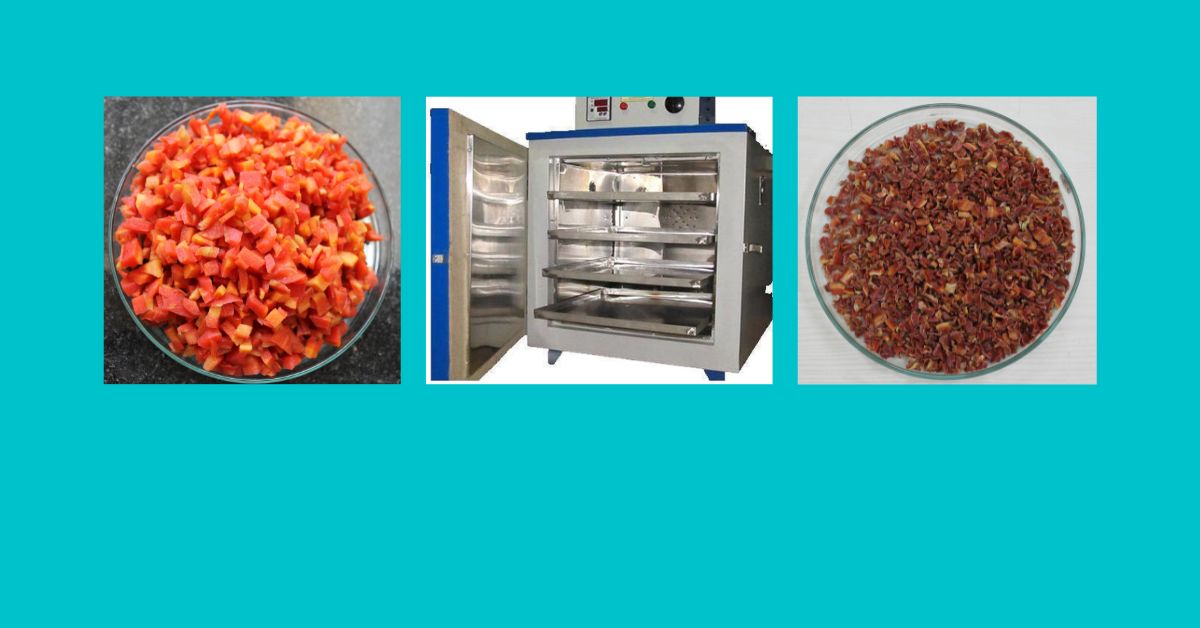
Determination of moisture content by hot air oven method
Practical: Determination of moisture content by hot air oven method
Title:
Determination of Moisture Content by the Hot-Air Oven Drying Method
Objective:
To determine the moisture content of a given food or grain sample using the hot-air oven drying method.
Need and scope of the experiment:
Moisture content is an important quality parameter of food grains and affects their storage, processing, and quality. Moisture determination is therefore an important part of grain quality testing and grain testing equipment used in post-harvest operations.
Principle:
The hot-air oven method is based on the removal of moisture from a known quantity of sample by heating under controlled conditions. The sample is weighed before and after drying, and the loss in weight is considered to represent the moisture removed from the sample. The sample is dried until a constant weight is obtained.
Definition and Expression of Moisture Content:
Moisture content is the amount of water present in a food or grain sample, expressed as a percentage. It can be expressed on a wet basis (% wb) or a dry basis (% db), depending on whether the total sample weight or the dry matter weight is used as the basis for calculation.
The moisture content on wet basis (% wb) is the percentage of water present in the total weight of the sample.
Where, m = Moisture content, % wet basis, Wₘ = Weight of moisture (g), W𝒹 = Weight of dry matter (g)
Here, (Wₘ + W𝒹) represents the original weight of the sample.
Suppose a grain sample weighs 100 g, of which 20 g is water and 80 g is dry matter
Therefore, the moisture content of the grain is 20% wet basis (20% wb).
The moisture content on dry basis (% db) is the percentage of water present relative to the weight of dry matter in the sample.
Where, M = Moisture content, % dry basis, Wₘ = Weight of moisture (g), W𝒹 = Weight of dry matter (g)
Suppose a grain sample contains 20 g of water and 80 g of dry matter
Therefore, the moisture content of the grain is 25% dry basis (25% db).
The relationship between moisture content on wet basis (% wb) and dry basis (% db) is:
Example: For 20 % wet basis moisture
M =25% dry basis
To convert dry basis in to wet basis use following formula
Example: For 25 % dry basis moisture
m =20% wet basis
Remember: For the same sample, moisture content expressed on a dry basis is numerically higher than that expressed on a wet basis.
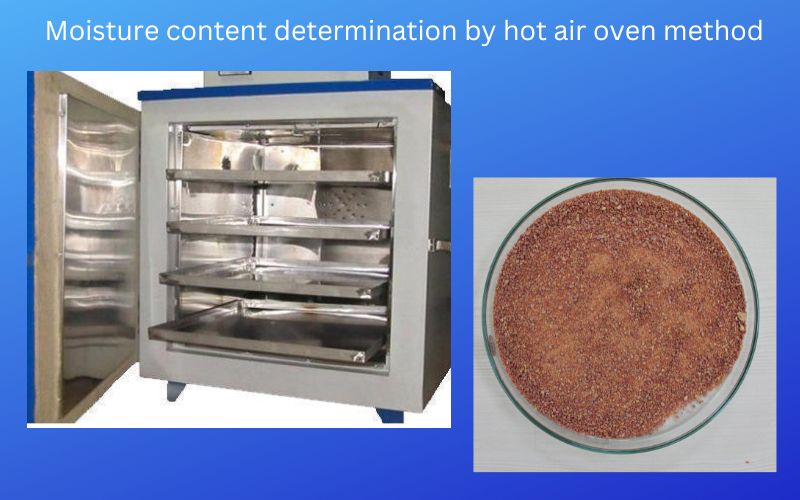
Materials and Apparatus Required:
The following materials and equipment are required for determination of moisture content by the hot air oven method:
- Grain or food sample
- Weighing container (Glass petri plate or metal moisture dish)
- Laboratory hot air oven
- Desiccator
- Laboratory weighing balance or analytical balance
- Grinder or mortar and pestle, when grinding of the sample is required
- Tongs for handling hot containers
Moisture content determination methods:
Moisture content can be determined by direct methods and indirect methods.
Direct Methods:
In direct methods, moisture is determined by removing water from the sample and measuring the resulting loss in weight. These methods are generally reliable but may require more time than indirect methods. The hot-air oven method and Brown-Duvel distillation method are examples of direct methods.
Indirect methods:
In indirect methods, moisture content is estimated by measuring a physical or electrical property of the sample that changes with moisture content. Electrical resistance and dielectric methods are common examples.
A grain moisture meter is a commonly used instrument for rapid estimation of moisture content in grains. Unlike the hot-air oven method, which determines moisture through loss in weight, a moisture meter generally estimates moisture from electrical properties of the grain.
Procedure:
Procedure for determining moisture content by hot air oven method is as follows.
- Clean the container or glass petri plate and weigh it. Note this weight of empty container as W1 (gram).
- Take approximately 5–6 g of the sample in the weighing container and record the combined weight of the container and sample as W₂ (gram).
- Place the container with the sample in the hot-air oven at the specified temperature. Dry the sample until a constant weight is obtained. Remove the container using tongs, cool it in a desiccator, and weigh it.
- Note this final constant weight as W3 (gram).
Determine the moisture content by formula
Where,
W1 = Weight of empty container, g
= Weight of container + sample before drying, g
= Weight of container + dried sample, g
(W2−W1)= Initial weight of sample
(W2−W3)= Loss in weight during drying
Observations:
| S.N | Sample Name | Replication 1 | Replication 2 | Replication 3 |
| 1 | Weight of empty container (W1) g | |||
| 2 | Weight of container + sample (W2) g | |||
| 3 | Weight of container + dried sample (W3) g | |||
| 4 | Moisture content, % wet basis m = [(W2-W3)/(W2-W1)] * 100 |
Result:
The moisture content of the given __________ sample was found to be __________ % wet basis.
The corresponding moisture content on dry basis was __________ % db.
Viva questions:
1. What is moisture content?
The amount of water present in a sample, expressed as a percentage.
2. Why is a hot-air oven used?
To remove moisture from the sample by controlled heating.
3. Why is a desiccator used?
To cool the dried sample without allowing it to absorb atmospheric moisture.
4. Why is constant weight required?
To ensure that moisture removal is essentially complete.
5. What is the difference between wet basis and dry basis?
Wet basis uses total sample weight as the basis, whereas dry basis uses dry matter weight.
6. Which value is numerically higher for the same sample—wet basis or dry basis?
Dry-basis moisture content.
7. What is the difference between a hot-air oven and a grain moisture meter?
A hot-air oven determines moisture content by drying the sample and measuring the loss in weight, whereas a grain moisture meter estimates moisture content from electrical properties of the grain. A hot-air oven is generally more suitable for laboratory-based reference measurements, while moisture meters are useful when rapid measurements are required during grain handling, storage, and quality control.


